Lucio Fontana: Genius of Two Worlds
The Museo de Arte Contemporáneo Atchugarry (MACA) is honored to present Lucio Fontana: Genius of Two Worlds, the first exhibition dedicated to the artist in Uruguay. This exhibition represents a major cultural milestone for the country and offers a unique opportunity to explore the universe of a creator who transformed the history of modern and contemporary art.
Lucio Fontana (1899–1968), born in Rosario, Argentina, and educated between Argentina and Italy, was an artist who transcended borders and disciplines. His work introduced a new conception of space in art, challenging the traditional limits of sculpture and painting and driving a profound transformation in 20th-century artistic practices.
Curated by Fontana specialist Luca Massimo Barbero, the exhibition brings together 72 works, including ceramics, sculptures, drawings, and canvases, tracing the different stages of the artist’s career—from his early sculptural and ceramic works to the celebrated Concetti spaziali, where matter, light, and void merge into a radically new visual language.
The exhibition journey allows visitors to explore his formative years in Rosario and at the Brera Academy in Milan; his experiments with ceramics and plaster during the 1930s; and his decisive return to Argentina in 1940, when the foundations of Spatialism emerged. With the White Manifesto, Fontana articulated the notion of “real space,” integrating art, science, and technology while anticipating conceptual and performative art.
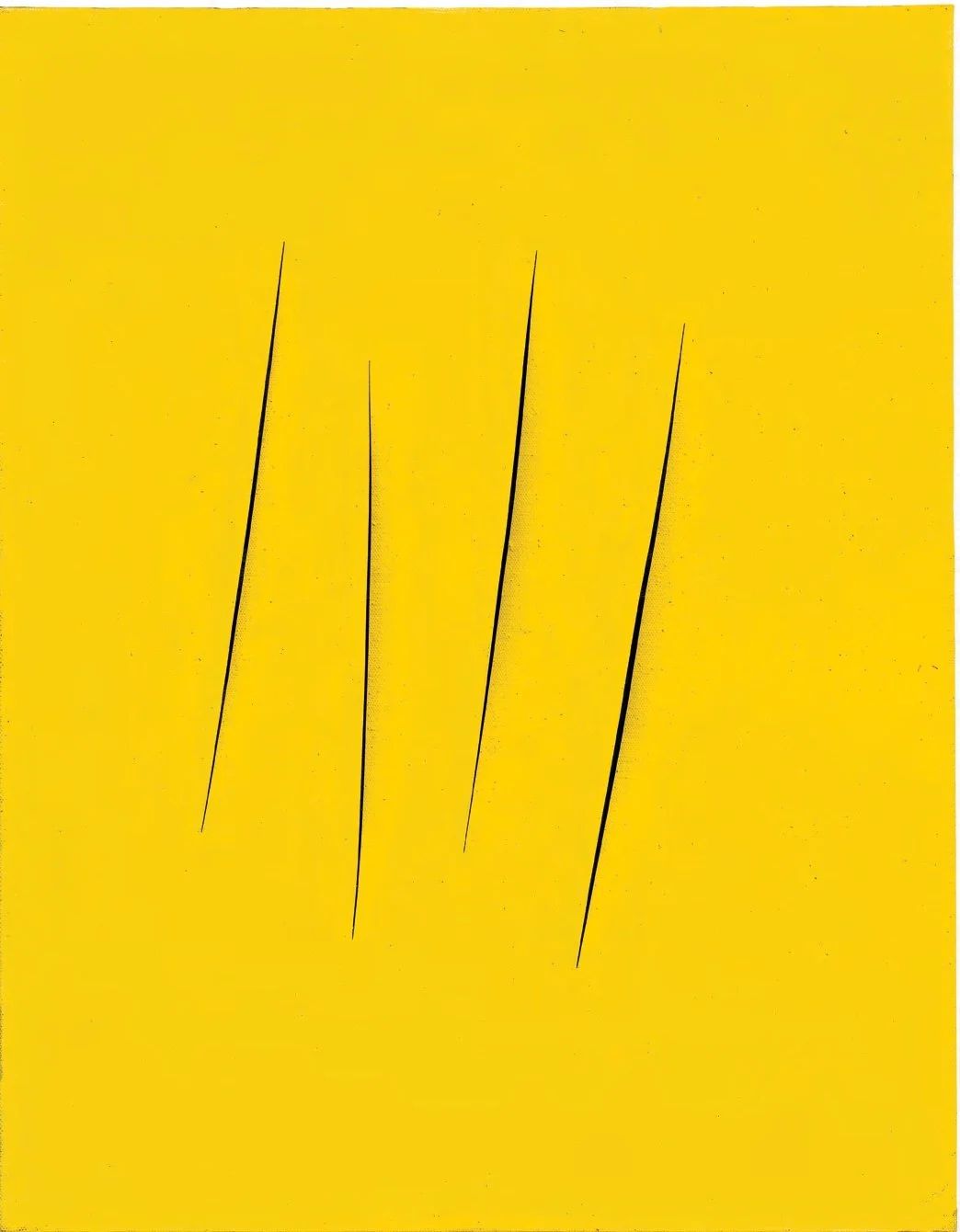
His iconic tagli—the slashes in the canvas—condense his artistic philosophy: a gesture opening toward infinity and a poetic reflection on matter, light, and void.
Through this exhibition, MACA reaffirms its commitment to the dissemination of modern and contemporary art and its mission to build bridges between Latin America and Europe. The exhibition invites the public to rediscover a creator whose vision continues to expand the boundaries of contemporary art.
The exhibition is accompanied by an illustrated catalogue, co-published by MACA and Allemandi Editore, featuring texts by Luca Massimo Barbero and previously unpublished graphic material, made possible thanks to the generous support of the Fondazione Lucio Fontana.
In the Words of Curator Luca Massimo Barbero
This exhibition, marking Lucio Fontana’s return to the Americas, Genius of Two Worlds, is a round-trip journey across the Atlantic. Internationally renowned for the tagli (Slashes) of the Attese (Expectations), this exceptional occasion also looks back to what came before: his formative years in his father’s workshop in Rosario and at the Brera Academy in Milan; the radical and turbulent 1930s, marked by plasters, drawings, and early kiln experiments, where ceramics immediately became a laboratory for extraordinary, telluric, and iridescent sculptures. This thread reappears throughout his entire career, alongside canvases and metals, as a rigorous and continuous practice.
His return to Argentina in 1940 opens a decisive chapter. In Buenos Aires, the concept of “real space” becomes method: alongside studies for the National Flag Monument and the remarkable San Juan, he develops the White Manifesto, which soon afterward, in Milan, gives rise to Spatialism. From this moment emerge the environments, where space becomes matter, like terracotta, and void takes on tangible form.
With Spatialism, the painting definitively leaves the frame and sculpture abandons the pedestal: the artwork is no longer an object, but an event and a state to be experienced. From this intuition emerges a complex and articulated lexicon, in which matter is first challenged through the buchi (holes)—“I make a hole, through it infinity passes, light passes…,” Fontana wrote—and later through the rigorous discipline of the tagli (slashes), which carry this poetic vision toward a strict and controlled dimension. “The slashes,” the artist noted, “are above all a philosophical statement, an act of faith in infinity, an affirmation of spirituality.”
This exhibition, which once again unites Italy and South America, revolves around two decisive aspects: training and method. From the earliest ceramics to the Attese, Fontana’s search maintains absolute coherence—a continuous line that makes space the substance of the work and light its vital breath.
About the Protagonists
Lucio Fontana (1899–1968)
One of the great protagonists of 20th-century art, founder of Spatialism, Fontana revolutionized the relationship between matter, light, and space, paving the way for conceptual and performative avant-gardes. His work is held in major museums worldwide, including MoMA (New York), Tate Modern (London), Centre Pompidou (Paris), and Museo del Novecento (Milan).
Luca Massimo Barbero (Turin, 1963)
Art historian and curator. Director of the Institute of Art History at the Fondazione Giorgio Cini and Scientific Advisor to the Fondazione Lucio Fontana. Former Associate Curator of the Peggy Guggenheim Collection (Venice), and author of foundational studies on the artist, including the Catalogue Raisonné of Works on Paper (2013) and the Catalogue of Ceramic Sculptures (2023).
Exhibition Details
Opening: January 6, 2026 — 6:00 PM
Dates: January 6 to March 31, 2026
Venue: MACA Museum — Gallery 2
Curator: Luca Massimo Barbero
Catalogue: Published by Allemandi / MACA